
Nassau Coliseum
January 3, 2004
NASSAU
COLISEUM
She started about 20 minutes late, and the extra wait was well rewarded. When she came out on the horse, the magic began. It was a great audience, and she responded well to us. We were a noisy bunch. She put on a great performance and seemed to be enjoying herself. I did not think she was rushed at all, as some others have reported. Rote, I don't think so. She wrings herself and the audience out, emotionally, and her performance is far from rote. Her very emotional rendition of “Skylark” started my tears. Her voice was wonderful and has matured so much since the first time I saw her at The Palace in NY in the 70’s. “I Think It’s Gonna Rain Today” was another tear jerker for me, and she was very emotional during that song. What can you say about “The Rose”, “Wind Beneath My Wings”, “From a Distance”, “When a Man Loves a Woman”. Oy, get me more hankies!!! The audience was overwhelmed. Her song with Mr. Rogers and the “September” song were beautiful. As for the for the political humor, we have grown to expect those lines from her. She has always done them, and I hope she always will! And as Bette always says, “Fuck ‘em if they can't take a joke!” The Soph jokes were great, as usual! And the Delores stuff, which I was not looking forward to (how many years can you see this, I thought), was really different and most enjoyable. New story, different take, the Broadway theme made it, for me! I was thinking during the medley, that I would enjoy hearing her sing a few of them without the parody, especially “And I am telling you I'm not going”. Wow, she would knock the stuffing out of that one… She did several local jokes, including ones about parking in a nearby mall, called “Roosevelt Field”, and knowing real fear, and about sharing some Enterman’s Cake (a local brand), and several others. Very funny! As for the songs left out or changes made, well that's what a tour is like. It is not the same, exact show each and every time. I remember during one tour, I went to 5 shows. They were all different, in some way, but all fantastic! That is the excitement of a live performance, especially from Bette. Leave some songs out, put some in, omit some clips, add new one- liners, but always a completely emotional, funny, touching, happy, glorious evening, like the “roller coaster” ride she mentions. It's been several years (too long for me!) since the Divine Ms Millennium Tour, and who knows when we will see another tour, so enjoy each and every minute. I know I did……………..My friends and I had a glorious evening. We were emotionally spent, and I know one big-mouthed woman (ME), who was silent, the entire car ride home. Now where is that piggy bank, and how can I get up the change to go again? The New York Times Ms. Midler has mastered the art of pastiche, and when she performed at Nassau Coliseum tonight, she put on a show that was both enormously entertaining and, in its own cheerful way, unsettling. Syrupy standards gave way to wisecracks and gentle antiwar slogans; familiar show tunes crash-landed in the middle of surreal skits. Ms. Midler constantly juxtaposed nonsense and sentiment, until it became hard to tell the two apart. The centerpiece of the show was "Fish Tales," Ms. Midler's long-running story of a singing mermaid with dreams of, um, making a splash. The skit gives her a chance to roast some Broadway chestnuts; if you're wondering exactly how shameless she can be, the words "All That Shad" should tell you all you need to know. Ms. Midler has been performing "Fish Tales" for decades, yet the skit's central gag is as funny and as startling as ever. Squeezed into skin-tight mermaid costumes, Ms. Midler and her three backup singers can't walk, so they flop and crawl and drag themselves across the stage. As anyone who has ever seen Ms. Midler knows, these mermaids have a secret weapon: motorized wheelchairs. In their chairs, the mermaids became suddenly graceful and playful, zooming around as if they were back in the sea. The unforgettable image of four mermaids in wheelchairs hints at the complicated relationship between ability and disability, between beauty and vulnerability, but to her credit Ms. Midler drew no such conclusions herself — she merely made lots of piscatorial puns and moved on to the next number. A few months ago she released "Bette Midler Sings the Rosemary Clooney Songbook" (Columbia), a less-than-satisfying tribute album, and tonight's performance included a rather blank, if sturdy, rendition of "Tenderly." But Ms. Midler wisely decided not to lean too heavily on the Clooney catalog. By contrast, another tribute was unexpectedly moving. She sang a gentle song called "I Like to Be Told" with an image of Fred Rogers — the late children's television star Mister Rogers — projected behind her. Compared with his effusive partner, Mr. Rogers was deliciously inscrutable; when he sang "I like to be told if it's going to hurt," he seemed to be impersonating both a precocious child and a desperate lover. But the duet also emphasized his subtle flamboyance. To see his image on Ms. Midler's stage was to notice, for the first time, the brightness of his cardigan, the ostentatious way he changed his shoes. In Ms. Midler's world, everyone's a diva. The show didn't shy away from current events, not all of them momentous. The star earned only muted applause when she joked about "certain world leaders" who don't explain things because they can't pronounce them, and she sang a dovish ballad that asked, "Will we keep reliving September/ Or will we learn?" She sounded more defiant when chronicling another war: the struggle over "Bette," her failed CBS sitcom. "Who loves me, even though I'm canceled?," she sang, and then she answered her own question: "Nobody but the Jews." And so, when it finally came time for the tear-jerking ballads, it was impossible to hear them the same way. "Wind Beneath My Wings" is generally interpreted as an inspirational ode to friendship, but Ms. Midler made it seem more like a witty portrait of self-absorption, sung by a star who thinks she's paying tribute to a friend when she's really just showing off. As her voice soared higher and higher, there could be no mistaking who had the wings and who was merely wind. The show ended with an encore, a reprise of "Friends." Ms. Midler noted that she has been singing this song forever but said, "I never meant it any more than I mean it tonight." And her huge, sly smile invited listeners to finish the thought: ". . . or any less." Back and Bette-r
than ever
Bette Midler and her backup singers belt out a number at Nassau Saturday night for the Divine Miss M's adoring fans. Cher. Streisand. Tina Turner. They've all retired from touring in the last few years. Which leaves Bette Mider, at 58, as the last of our older female superstars still willing to hit the road. And she's hitting it with gusto on her new "Kiss My Brass" tour. It's Bette's first show in four years and her biggest to date. It's also the star's loudest - given the inclusion of the brass section alluded to in its title. Perhaps most notably of all, it's the first Bette tour to include something as sentimental as - I-kid-you-not - an un-ironic tribute to Mister Rogers' Neighborhood. "Brass," which first swung into the tri-state area on Wednesday at Mohegan Sun in Connecticut, and which hit Nassau Coliseum Saturday, tempers Bette's eagerly coarse persona with more nostalgia than any show of the star's 30-year career. That came across in more than just her warm performance of Fred Rogers' ode to childhood dependence, "I Like To Be Told." "How did we go from a song like 'Tenderly' to 'Bitch Better Have My Money'?," asked Bette in one of her many critiques of modern culture. "These days you're not considered a serious entertainer unless you dress like a 'ho'," she said, going on to aim zingers at Britney Spears and Christina Aguilera. It's a long way from the free-wheeling sensibility of the gay baths, where Bette played in the early '70s. Luckily, the show's softer edge didn't diminish its pleasure. Also, you should know, the two-hour and 15-minute show did boast plenty of bawdy jokes, salty language, and trashy fun. But it was all in the service of stressing old-fashioned entertainment, which only amplified the singer's traditional side. In a sense, Bette has always been a traditionalist. Long before the current vogue for re-interpreting standards (as epitomized by Rod Stewart), she helped keep songs of the pre-rock era thriving in front of a large and vital audience. At Nassau Coliseum, she dipped far back into history for Johnny Mercer and Hoagy Carmichael's "Skylark," a song included on her second album from 1973. The singer had never before featured it on a national tour. A highlight of the night, her performance allowed Bette to show the more supple qualities of her voice, and the yearning she can conjure. Bette reached back even farther for "Boogie Woogie Buggle Boy," one of several big band swing numbers used here to show off her five-man horn section. Given Bette's long-time use of those instruments on album, it's a wonder it took her this long to feature them live. The brass, borrowed from The Royal Crown Revue, gave all the songs extra punch. Bette upped the evening's pizzazz with its splashy theatrics. Inspired by Coney Island, the staging featured beach murals, cabanas, ferris wheels, and even a merry-go-round horse that whisked the singer on and off stage in act one. The tour also included her first use of a filmed comedy skit (the better to give the star time to catch her breath). It featured Judge Judy condemning Bette for the canceled sitcom she so publicly detested. Judy sentenced her to "apologize to everyone who ever owned, or might have owned, a television set." Of course, there was also the usual set of Sophie Tucker jokes, plus an over-long revival of her circus sideshow character Delores Del-Lago, which included rewrites of Broadway songs ranging from "Everything's Coming Up Roses" to "You'll Never Walk Alone." "I may be a freak," said Delores at one point, "But I'm a freak with a dream." Indeed, Bette remains a glorious freak in modern pop. She's the only major star whose repertoire locates an improbable connection between R&B, blues-rock, standards, show tunes, girl-group hits and more. In this one show, Bette offered songs associated with Clooney (to whom she recently recorded a tribute album), Tom Waits, Randy Newman, Percy Sledge, Bob Fosse, The Andrews Sisters, and even the aforementioned Mr. Rogers. She was equally convincing on Waits' moving ballad "Shiver Me Timbers" as on the glitzy '60s wedding standard "Chapel Of Love." Given her age, it's no surprise that Bette has mellowed some. Luckily, the mild dimming has made her no less divine. "Kiss My Brass" comes to Madison Square Garden Jan. 17-18. The New Yorker
Magazine That artistry was on full display once Midler took the stage at the Nassau Coliseum—which for the first act was designed to resemble Coney Island (though it oddly reminded me more of the Moscow skyline). Midler arrived on a mechanical horse, like a Jewish Lady Godiva. I never got the point of the horse or the backdrop, but over the next two and a half hours Midler gave us no time to worry about what they or anything else might be supposed to mean. Dressed in blue satin sailor pants, a sheer sailor blouse with anchors stitched on its short sleeves, and a sailor cap that was set rakishly on her mop of Lucille Ballish red curls, Midler began by dismissing the horse she rode in on (“Beat it, Seabiscuit!”) and blasting us with applause-raising cries of “I’m not going to retire yet!” Then, with her three backup singer-dancers, the Harlettes, she minced and sashayed across the stage, describing everything she’d gone through to give us the show we were about to see. “This is the biggest thing I’ve ever done, ladies and gentlemen,” she said, bullying us into believing it. “We’ve got shit backstage that I’ve never seen!” She briefly established her political leanings—“Poor Rush Limbaugh! Poor, fat, stupid, hypocritical, drug-addicted Rush!” And then she went in for the kill. “I’ve seen the young people,” she said, casting a sidelong glance at the audience. “I’ve seen Christina Aguilera,” she sniffed. “She was wearing pasties and garters! All these new girls are so trashy!” Beat. “And do I get a thank-you note? I opened the door to trash! I was trashy before any of these girls were born!” Having staked out her territory in contemporary culture, Midler felt ready to introduce—or reintroduce—us to her past. She left the stage for a moment, and three video screens descended from the rafters. There, onscreen, was the Divine Miss M. as she had appeared thirty years before—frizzy hair, plucked eyebrows, big clunky platform shoes—kicking it to what has become one of her signature tunes: “The Boogie Woogie Bugle Boy.” But, just as we were about to settle into a warm bath of nostalgia, the present-day Midler took the stage again, singing and dancing along even more gleefully than her former self. Having been around long enough to experience her share of pain, Midler seemed to be telling us, she can now experience greater joy. To prove the point, she then regaled the audience—again from the video screens—with a skit about the failure of her 2000-01 TV sitcom, “Bette.” The video showed Judge Judy admonishing Midler for having trashed CBS after the network cancelled her show. Just as the entertainer began to argue in her own defense, she was trumped by a clip of herself telling David Letterman that CBS had made her feel like a “dung beetle.” Cut to: Midler, onstage, intoning, “Who cares if my show is cancelled? . . . My people! The Jews.” Cue: “Hava Nagilah.” Then: “Who gives a damn if my career’s in the toilet? . . . My people! The queens! Hello, girlfriend!” Of course, by acknowledging her core fan base, Midler was again acknowledging her past, the cult of difference that grew up around her and a number of other female artists of her generation—most notably the Pointer Sisters—whose allure had less to do with their musicianship than with their marginalization, the way they used their own cultural identification, along with a heavy dose of gay irony, to get their shows across. During the twenty-minute intermission that divides the show’s two acts (the first is stronger than the second, which relies too heavily on old shticks that didn’t work to begin with), it occurred to me that I had never actually seen Midler live before. She is so palpable as an icon that I had confused her many appearances on TV and in movies and my knowledge of the general Midler lore—goofy-looking Semitic girl, born and raised in Hawaii, moves to New York, lands a role in the original Broadway production of “Fiddler on the Roof” while moonlighting as a cabaret singer, and the rest is history—with her actual presence. But unlike other icons, such as Marlene Dietrich or Judy Garland, whose legendary status was based partly on their beauty and partly on their narrow escapes from disaster—Nazis and drugs, respectively—Midler is a blue-collar heroine: a Rosie the Riveter, whose strength, rather than her looks, gets her through. She isn’t glamorous or fragile; rather, she is a kind of hysterical variation on your Aunt Sadie, who made a career out of entertaining with family lore while boiling up a batch of chicken soup. Her appeal has to do not with her diva qualities but with her ability to be a parody of a diva—to be as grand as Norma Shearer in “Idiot’s Delight” while at the same time behaving like an idiot. Beneath Midler’s boss-lady antics and psychodramas—her complaints about her exhaustion and her backstage crew—there is a truly democratic style and spirit. Nothing pleases the citizens of a democratic society more than sending up the aristocracy, and, in America, stars are the only aristocracy we have. Midler, even as an aristocrat, has never lost her outsider status, because she never fails to refer back to her roots. She’s the perennial émigrée in show business, the tough Jewish girl from the sticks who continues to charm the Gentiles with her moxie and her anxiety; no matter how big she gets, she reassures us, her background, her religion, will keep her small. And since she’ll never be one of them, why not make a joke out of the reality, and surreality, of her down-to-earth self? By adopting certain elements of postwar American culture for her stage act (her underrated film “For the Boys” was in part a homage to the songs of that era), Midler has been able to manipulate the combination of skepticism and optimism with which Americans meet any call to arms. Her penchant for nostalgia—in addition to “Boogie Woogie,” she sang a lovely cover of Rosemary Clooney’s “Tenderly”—is a distinctly American impulse, too. Audiences here aren’t ashamed of sentimentality; the spectators at the Nassau Coliseum were happy to cry and sing along with Midler’s soppy standby “The Rose.” But it was when she performed Tom Waits’s ballad “Shiver Me Timbers”—a song about running away to sea—that Midler truly put the audience in her pocket. Center stage, with a spotlight on her face, she used her hands with the expressiveness of a mime to trace waves through the air, and she used her voice—with its particular mixture of Broadway, Motown, and amped-up Phoebe Snow—to travel to that place we all inhabit: the land between time present and time past. |
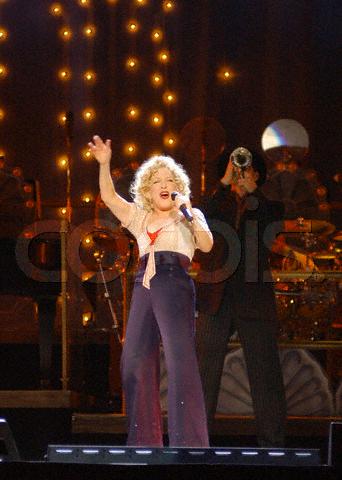 I
am deliriously happy to report I saw The Divine One, tonight. Oh,
my gawd! She was fantastic. We had great seats. I stressed so much
about sneaking in my camera, and we got it in, no problem. As soon
as the lights went out, I take out the camera, and I am not using
any flash, but the “Bad Man” saw me, came over and made me put it
away. Oh well, I was disappointed, but it took the pressure off
paying attention to the camera, and I could focus on Bette completely.
I
am deliriously happy to report I saw The Divine One, tonight. Oh,
my gawd! She was fantastic. We had great seats. I stressed so much
about sneaking in my camera, and we got it in, no problem. As soon
as the lights went out, I take out the camera, and I am not using
any flash, but the “Bad Man” saw me, came over and made me put it
away. Oh well, I was disappointed, but it took the pressure off
paying attention to the camera, and I could focus on Bette completely.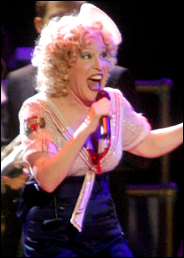 that
they mean what they sing. But Bette Midler couldn't care less. She's
best known for her sentimental ballads, but her current show, "Kiss
My Brass," is a delirious, freewheeling celebration of phoniness.
that
they mean what they sing. But Bette Midler couldn't care less. She's
best known for her sentimental ballads, but her current show, "Kiss
My Brass," is a delirious, freewheeling celebration of phoniness.
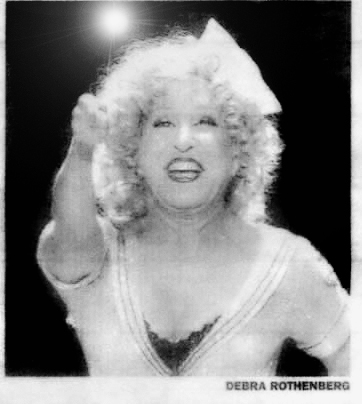 Bette
Midler, at Mohegan Sun in Connecticut on New Year's Eve, moved to
Nassau Coliseum over the weekend.
Bette
Midler, at Mohegan Sun in Connecticut on New Year's Eve, moved to
Nassau Coliseum over the weekend. 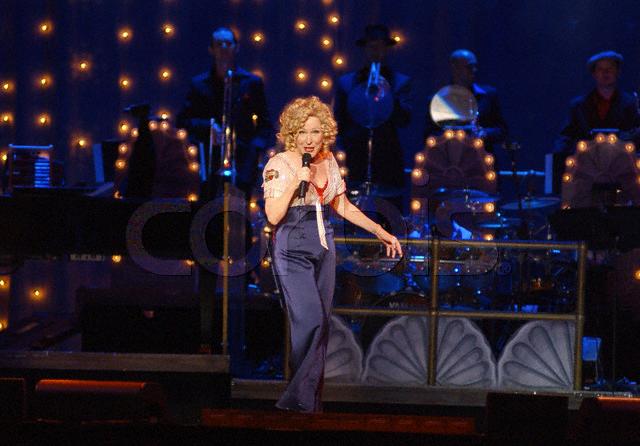 March 2nd), you’ll be reminded not only what a star is but what
makes Midler such a great one. Even before she got to work on January
3rd at the Nassau Coliseum, in Uniondale, Long Island, where I saw
the show, Midler was in evidence everywhere—not least in the memories
of those who had come to see her.
March 2nd), you’ll be reminded not only what a star is but what
makes Midler such a great one. Even before she got to work on January
3rd at the Nassau Coliseum, in Uniondale, Long Island, where I saw
the show, Midler was in evidence everywhere—not least in the memories
of those who had come to see her.