
Henry Edwards: New York Times
While most pop superstars produce at least one new disk a season, it has taken Bette Midler two years to record “Songs for the New Depression,” her about-to-be released third LP. Why?
“I was spooked by the difficulties I had making my first two albums,” explained the flamboyant vocalist the other day as she prepared for a cross – country tour which will open in Seattle on Dec. 10, “and Rolling Stone’s extremely negative review of my second album scared the daylights out of me.”
It took Bette many months before she found a producer able to translate her vivid theatricalism into a successful recording. Among the false starts was a visit to Motown’s Los Angeles studio where Midler became the first white woman to record under the Motown aegis. “You go in and you sing and if you ain’t got it, they tell you: ‘Sorry! You are out!'” she recalls. “Needless to say, I appreciated the discipline of the Motown experience even though it was at odds with my rather painstaking approach.”
Another false start found her recording with and being produced by Paul Simon. “I put my two cents in once too often for Paul’s taste,” is how she explains the failure of that collaboration.
With keyboardist-composer Moogy Klingman, proprietor of the Secret Sound, a local recording studio, Bette began to record a sample of original compositions that she and Klingman had composed. Pleased by the results, she settled down to a 12-hours-a-day, six-days-a-week schedule which lasted throughout the summer and into the fall. Nineteen Midler originals were recorded, though only two appear on “Songs for the New Depression.”
My songs are so dizzy they are out to lunch. After two years, I decided the least I could be was commercial.”
The “commercial” disk will include songs by Phoebe Snow and ‘loin Waits, an excursion info the reggae beat and new renditions of “Strangers in the Night,” “Old Cape Cod” (a hit for Patti Page in 1954), “Marijuana” (plucked from a 1934 film “Murder at the Vanities”) and Bob Dylan’s “Buckets of Rain,” with Dylan himself, singing harmony. “He was real lively,” reports Miss Midler.
Will another bad review in Rolling Stone result in two more years of trial and error? She replies: “I’m stronger this time around and 1’m not as easily scared. I also know that I’ve really done the best that I could. I like this record and whatever anyone else may feet about it, I really sang my heart out.”
out.”
Steven Gaines: New York Sunday News
“Songs For The New Depression doesn’t lift mine, financially or psychological. From the art design down to the music on the album, it’s a hipper-than-thou package that uses more energy being chic than it does being musical . . . during some of the songs, like the reggae ‘Marahuana’ or ‘Buckets Of Rain’ . . . you get the feeling you could be listening to a Lily Tomlin comedy album . . . On most of the eleven cuts Midler sounds as if she had nasal congestion or she had regressed to age even through hypnosis. For a gifted thirty-year-old, that’s too infantile . . .“
Robert Christgau
It’s going too far to claim that she’s taken on a corporate personality–a very unusual individual does definitely peek out through the curtain of groupthink that hides these songs from the singer and from us. But that individual seems to have taken on so many advisers because she’s afraid of herself, and such fear is not attractive in an artist of Bette Midler’s power. No matter what your voice teachers tell you, wackiness is not something to modulate. C+
David Tipmore: The Village Voice
“. . . each song is like a petite showcase for future movie roles, demonstrating a supposedly versatile actress who, moreover, can carry a tune . . . this extensive posturing makes Midler sound absolutely unavailable: distant, electronic, hoarse, and scared . . . this is not unpredictable. Any ‘actress’ who also sings is not at home in a recording studio. She needs the dimension of theater to fully incorporate her personality into her product . . . [Songs For The New Depression] is the first record I have ever heard which aims for an Academy Award. And as such, the record was a big mistake.”
Unknown Author: Unknown Publishing
It’s difficult to pinpoint exactly what is wrong with this album. There is nothing artistically offensive about it. Midler is in good voice, her backup musicians are strong and well-chosen and the mix of solid contemporary material and older works is not objectionable.
Perhaps the most obvious lack is a sense of excitement. Expecting to find live performance energy on a record is a major mistake for any listener, but one would hope to find more drive than there is on “Songs.” It may well be that, like Barbra Streisand and others, Midler draws her persuasive abilities from an audience and not necessarily from the songs. The audience and the applause are near and dear to her heart, not the lyrics of individual works.
There also seems to be a certain lack of focus to the album. Three producers – with three different styles – worked on “Songs” with two cuts each from Arif Mardin and Joel Dorn and the rest by Moogy Klingman, a member of Todd Rungren’s Utopia. As a result, the album as a whole lacks unity of perception.
Individually, however, most of the cuts work rather well. A disco version of “Strangers In The Night,” jarring at first, proves surprisingly strong after repeated listening. Midler does well by Phoebe Snow’s “I Don’t Want The Night To End,” Klingman’s “Let Me Just Follow Behind” and, especially, Tom Wait’s “Shiver Me Timbers.” Her version of Bob Dylan’s “Buckets Of Rain,” sung with Dylan, is a triumph.
That old chestnut “Tragedy” simply drags along, however. “Old Cape Cod” is done just as the Andrews Sisters did it, which makes it a bit too similar to “Boogie Woogie Bugle Boy.” Midler’s own “Rocky” and “Marahuana” should prove to be fine stage pieces, but neither is particularly striking on the record.
Midler’s future is unlikely to be decided by “Songs For The New Depression.” She is too great a stage performer and vocalist for her to ever have to return to the New York cabaret scene. Unfortunately, “Songs” is not as strong or as indicative of her talents as it might have been.
Stephen Holden: Rolling Stone Magazine
It took Bette Midler two and a half years to make her third album. But all Songs for the New Depression does is once again raise the question of how this gifted stage personality can capture on a record the ebullience, spontaneity and imagination of her performances. Clearly, as her selection of good, recent songs by Bob Dylan, Tom Waits, Nick Holmes and Phoebe Snow indicates, Midler wishes to be regarded as a versatile recording artist of mostly contemporary material as well as a popular entertainer. Yet these are the wrong songs sung poorly. Midler sounds so tense and intimidated by studio problems that her personality is scarcely evident on this album. Ultimately, Songs for the New Depression is a failure because it comes to life only in its trivial endeavors, which is exactly what wasn’t supposed to happen.
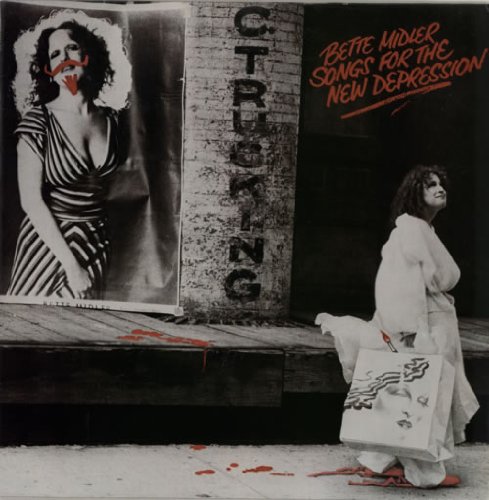
The cover portrays Midler rejecting her “Divine Miss M” persona in order to move in a new direction. But the album itself suggests confusion; Midler inexplicably submits to arrangements and production values that strut their own cleverness rather than showcase her talents. Producer Moogy Klingman undermines Midler’s gift for dramatic monologue either by echoing or multitracking her vocals in arrangements as stiff as they are misconceived. An abridged version of Phoebe Snow’s “I Don’t Want the Night to End,” set as an R&B ballad of sorts, drowns Midler’s individuality in echoes, while the arrangement turns an excellent song into bathetic schlock. Tom Waits’s “Shiver Me Timbers,” a high point in Midler’s live act, sinks under the weight of an arrangement so literal-minded that it includes the sound of mewing sea gulls. The Fifties hit “Tragedy,” with expansive choral backup and chimes, is neither spoof nor tear-jerker.
Along with the totally misguided attempt at reggae (“No Jestering”), the album’s excruciating nadir is a disco version of “Strangers in the Night” (produced by Arif Mardin in a style similar to the Bee Gees’ “Fanny”), in which Midler shrieks about a half-tone flat from beginning to end. In more relaxed settings, Midler’s severe pitch problems can be overlooked-indeed, they can serve her dramatic style, as in “Hello in There.” But it seems the height of stubborn self-destructiveness for Midler to ape Gloria Gaynor, fall short so badly and then allow the result to stand.
Midler sounds relaxed only in the two cuts she coproduced with Joel Dorn, whose previous work with her has been her best. A revival of the Patti Page hit “Old Cape Cod” is comfortably nostalgic. On “Marahuana,” an obscure Thirties film tune, Midler camps it up a la Carmen Miranda to re-create the period piece in her own image. Though a very trivial song, it’s at least fun.
On Midler’s duet with Dylan on a lyrically revised “Buckets of Rain,” Dylan’s backup vocal is unaccountably mixed much higher than the lead; the song sounds like a Dylan self-parody. Midler’s own attempts at writing-a phone-call song to “Mr. Rockefeller” and her humorous interpretation of the “Welcome to My Nightmare” slogan in “Samedi et Vendredi” (sung entirely in French)-will at least appeal to Midler’s claque. Both pieces, however, are closer to show-biz bits than to fully realized songs, and Klingman’s production again fails to enhance their humor.
Trivia, nostalgia and camp may validate and sustain the worth of a stage career, but they sure as hell can’t do it for a singing career that asks to be taken seriously.
M.A.: Unknown Publishing
“Strangers In The Night” was one of those bright-idea tracks, arranged courageously by Arif Mardin. But nothing, including humor, will ever make me want to listen to that song. “Samedi eh Vendredi,” written by Midler and Moogy Klingman, may be the best. “No Jestering” is a very well-sung reggae, the same dreary reggae sound thrown into every other album these days.
The seven tracks arranged and produced by Klingman are the most contemporary sounding; they seem to be the best direction for Midler. Camp can be fun, but I feel most serious about her when she is serious about herself.
Getting success is heady. Keeping it is serious business. This album of Bette Midler does not define her career nor spark it. But it maintains.
Aaron Russo
“Bette loves that album. I didn’t care for it, didn’t think it was something the public wanted to hear, and I didn’t think they got the essence of Bette Midler on it. The choice of material was not the best, the production wasn’t particularly terrific and I thought it was something she was doing for her own satisfaction, as opposed to the publics. I didn’t feel anything commercial on that album – and I don’t mean commercial in the trite sense; I mean things people can relate to.”
“I think the thing with Dylan on Bette’s last album was a mistake. The song had nothing to do with the album at all. What happened was Dylan wanted [Bette] to be in his Rolling Thunder Revue movie. They were talking about it and she said, ‘Well, there’s a possibility I’ll do it, but I would like you to sing a song with me., He came to the studio one night and they just went out and did this piece. I don’t think it was thought out and planned. It doesn’t sound like it. I fought putting it on the album . . . it was something they wanted to put in so maybe her and Dylan could have a single out of it – that to me is trite commercialism.”
Bette Midler
“It was a great learning experience. On the first two albums, I really wasn’t there most of the time. I would come in and do my vocals and go home because I didn’t know anything about recording studios. This time, however, I got involved. It forced me to think about what I wanted to do with my music. It also taught me to trust my singing. I was full of self-doubt. I had considered myself a performer, but not necessarily a singer or musician. This record contains some of the best singing I have done, and that made me happy. It filled me with positivism . . .”
“That little person [on the cover ] is supposed to be a harbinger of joy. I love her very much, especially the fact that she never ties her tow shoes. She is the singer on that album . . . it’s meant to be very innocent. It’s meant to be a harkening back to a kind of innocence that has been bypassed and I feel very strongly a need to return to . . .”
“I’m not ashamed of New Depression, I thought 1974 and 1975 were a Depression; desolate. Nixon had quit, all those awful ‘snuff’ porn murder films came out and the Anvil [a Chelsea butch/S&M; bar] was getting a lot of press and I thought, ‘People are going to start killing each other! I have to make some kind of statement!’ Which was to pull back.”
“The dress I’m wearing [on the album cover] isn’t really a dress; it’s made up of fourteen skirts, a pair of painter’s pants, rights, odds-and-ends – the effect being a ‘bag lady’ or rather the ghost of one. She’s all in white, you see, so it’s my fantasy. At the time, I thought it was the end of the world, so I was making a very whimsical, reactionary album . . . little did I know there was no market for whimsy that year. I thought the record was really gonna go somewhere but I made a miscalculation. So there I am in my red shows – and now I have to clump about in them for the rest of my life.”
Bette Talking About Recording Albums
“The second record, Bette Midler, came out and sold well, but I made the mistake of reading the reviews and I never really was the same again. Some of the reviews said I wasn’t a good singer and they were really cruel. I felt horrible. I had made some mistakes, but I didn’t think they were worthy of such scathing comment. I decided that I was really a soprano. I’m not a soprano, I’m an alto. I decided I should write my own music, so I wrote a whole record in 1974. The label heard it and they got really upset and didn’t want me to put it out. They went back into old tracks I had cut for my first two albums and slapped them onto a third record. That was the beginning of the end of my interest in a recording career. The worst part of it was they convinced me at the time that I had to chase the charts. I really couldn’t chase the charts because I was too idiosyncratic, too eccentric for the charts. I wasn’t mainstream, and they tried to push me into the mainstream and I couldn’t do it. �
“I tried, and that was the heartbreak of it, that I was trying. I couldn’t really stand up to those assholes. I wanted to please, and when I couldn’t please, I lost interest. But rather than stand up for myself, I made a couple of records that were really not very good. You get into the studio with those twenty-four/forty-eight tracks, and by the time they’re done with you, it’s not even a human being who is singing anymore. It’s a machine. My voice is a very warm voice, and what I have to say, what I have to sell or what I am about, is human emotion, either raw or somewhat refined or humorous, but always human. After a while my records sounded like a machine was singing on them. I cut a record here and I cut a record there and I guess it was apparent that I wasn’t all that interested because people stopped buying them.