
Steven Gaines: Circus
For a star of the first magnitude, Bette Midler burns with surprisingly little starlight. Her career reached a frenzied peak three years ago, with an appearance at New York’s Palace Theatre, and has been fizzling since, like a damp rocket. She hasn’t had a hit single since “Boogie Woogie Bugle Boy” and of her first four albums -released at a snail’s pace of one every 18 months – only the first went gold. She’s best appreciated in live performance, but Bette only plays small theaters, and tickets are expensive and hard to get. Film producers, who make offers constantly, have so far gotten only half-commitments.
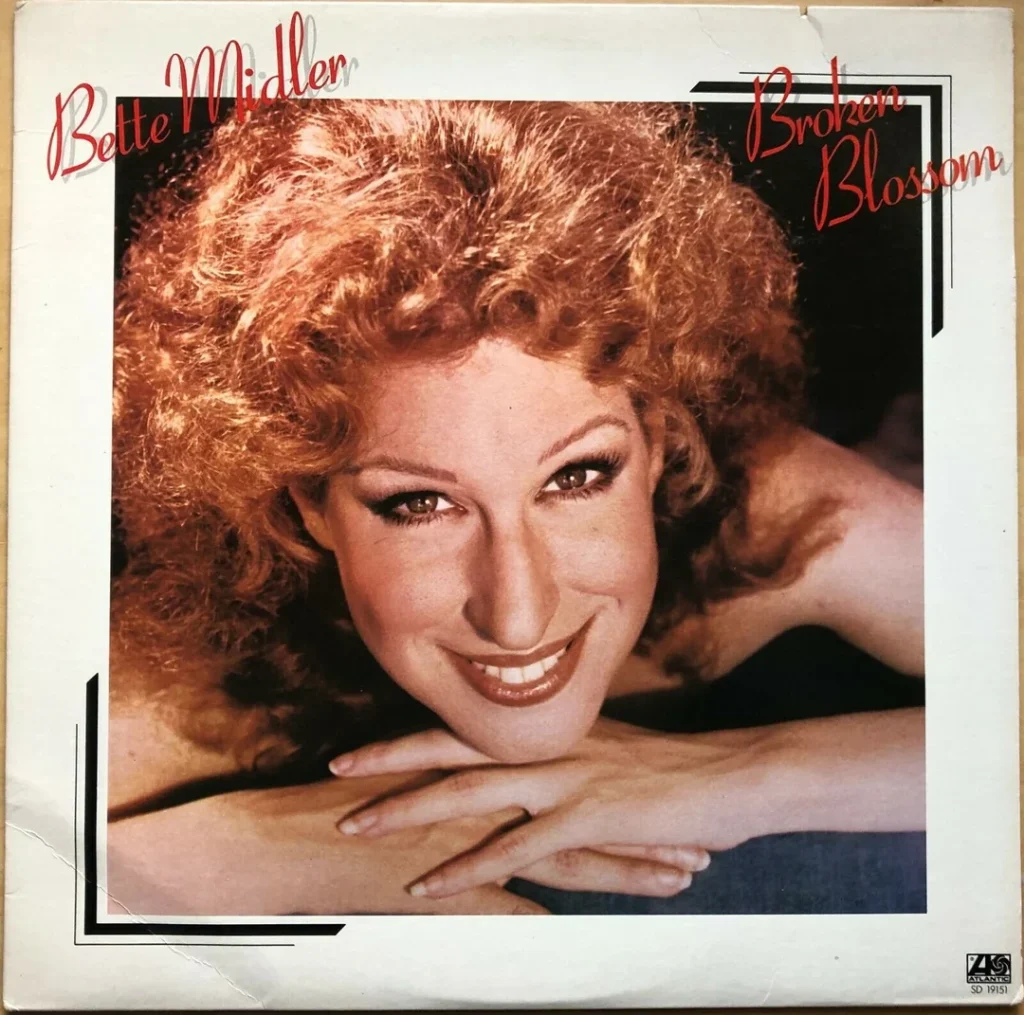
But Bette Midler on the backburners is worth two of anybody else cooking up front. A born genius with a wit and delivery that can mesmerize an audience, if she is destined only to be enjoyed by a small audience of the intelligentsia, at least her work is impeccable, as attested by Broken Blossom, her latest Atlantic LP. Nine months in the making, Broken Blossom is Bette Midler’s dearest, most striking album, with vocals worthy of Streisand backed by superb production by Brooks Arthur.
“I think people are crazy when they suggest I’m keeping myself on the back burners,” Bette says, despite the fact that she recently thanked Rolling Stone Magazine for keeping her career from peaking too soon. “Everybody talks about how slow things are going and how many vacations I take, when the truth of the matter is, I took off only two months in the last nine years. All right, I made some funny little records, but I liked them. They are certainly not like a recording anyone else would make.”
They’re also not the kind of recording that Bette’s manager, Aaron Russo, would have preferred she make. Concerned that her choice of material was too esoteric and indulgent, he begged her to think more commercially. Russo says of Broken Blossom, “This album will sell records and make Bette happy – both. It’s important to Bette that she combine commerciality with her personal integrity. Bette’s very headstrong about her career and we fight like cats and dogs about it. She’s an insecure woman who’s full of love, but she’s got a fiery temper.”
Producer Brooks Arthur is a man with a reputation for handling fiery temperaments, having produced hit albums for Janis Ian and Peter Allen. And it’s well known that Bette hates the studio process: “It’s so tedious and it can make you crazy,” she says. “Of course it’s a rough experience,” Arthur confirms. “Bette doesn’t feel like she’s accomplished enough unless she puts in eight or nine hours’ worth of work into it”
Arthur not only managed to keep Bette calm and sane, but he brought out a tender, better singer with big production numbers and wise instrumental choices. Together they culled music from “a satchel full of material,” including Billy Joel’s “Say Goodbye to Hollywood” and country singer Eddy Arnold’s “You Don’t Know Me.” “Story Book Children,” written by David Pomeranz, will be released as a single.
But although Arthur calls Bette’s version of Edith Piaf’s “La Vie En Rose” the sleeper of the album, the cut is less than invigorating, particularly when compared to the popular version by disco singer Grace Jones, which is an eye-opener. Other oldies, “A Dream Is A Wish Your Heart Makes” by Mack David and Arnold’s country ballad might leave cold any listener born post World War II.
The daughter of a New Jersey house painter who emigrated to Hawaii, Bette Midler’s first acting role was as an extra in the movie “Hawaii.” She bankrolled her $350 salary and headed for New York in 1965, where she hit the Broadway circuit, eventually playing Tevye’s oldest daughter in Fiddler on the Roof. A cabaret act at the Continental Baths came next, where she met Barry Manilow as her accompanist.
It was one of Bette’s feuds that allegedly affected the radio play of some of her records. Although the true story may never be known, it begins on a taxing New Year’s eve of 1976 in Los Angeles. Bette had just emerged from the hospital after spending her 30th birthday having her appendix removed, and she was a little harried and frantic about that night’s show at the Dorothy Chandler Pavilion.
Since California state statutes were being changed at midnight to reduce the penalty for possession of small amounts of marijuana to a misdemeanor, Bette wanted to tape a joint to the bottom of every seat of the theater as a New Year’s surprise. Her staff had purportedly rolled 1800 joints before word leaked out, and the district attorney’s office halted the project. Still determined to give her audience that little something extra, at the stroke of midnight, goes the story, Bette dropped the top of her dress, and manager Aaron Russo dropped the curtain.
“Aaron was furious with me,” Bette recalled, “and then I was at this big New Year’s industry party and it was all such an enormous strain and I was a little fuzzy. Someone introduced me to Paul Drew, the program director of all the RKO stations. He was holding my record and said he hated it.” So I grabbed the record from his hand, broke it across my knee, and smacked him across the face. And I’ve been banned from RKO stations since, although we recently had lunch together and made up. He dined out on that story for a year. What can I say? I’m really sorry it happened, but that’s show biz.”
What is Bette Midler after, and what does she want? “I’ve been looking forward to a chance to express myself, as corny as it sounds. I want to sing songs that I really like to sing, and to express this very peculiar point of view I have about life. I think that’s what strikes a chord in everyone who really likes me. The fact that I come out and say, Hey, what’s really going on, as simply and innocently as that. Life is kind of ordered chaos or complete dementia. It’s a constant process of learning, laughing, and giggling at it.
Peter Herbst: Rolling Stone Magazine
By now, it’s generally accepted that Bette Midler is more than just a pose. Her Continental Baths days long behind her, she has continued to deliver enough flashes of vocal originality to suggest a potentially seminal talent, one that has less to do with camp histrionics than with effective emotional phrasing and considerable artistic range.
Unfortunately, Midler still seems unsure of herself and too often displays a penchant for pointless excess that invariably results in her worst singing. Though she usually avoided such self-conscious rough edges on Songs for the New Depression, her last studio album, she doesn’t manage quite so well on the new one. Indeed, too much of the often charming Broken Blossom is rendered confusing and occasionally unpleasant by artificially revved-up endings and the aural equivalents of winking, near-leering posturing.
Midler doesn’t need these devices. On ballads such as “Storybook Children,” “Paradise,” and even the classic “La Vie En Rose,” her transitions from wispiness to full-bodied emoting are intelligent, meaningful, and well-executed. Even when she’s being deliberately campy on “Make Yourself Comfortable,” she demonstrates she can soft-sell humor; the scat singing here makes perfect sense.
Just as often, however, a tenderly wrought ballad will explode into gaudy overstatement. “You Don’t Know Me,” the Eddy Arnold/Cindy Walker country classic that became one of Ray Charles’ best singles, has enough tears in its lyrics to fill a tub and needs no more than a careful, sensitive rendition. Midler’s wild exercise in hand-wringing does nothing but poke fun at the song, and I doubt that’s what she had in mind. It just seems that sometimes Midler is so uncomfortable when she’s merely singing a song that she feels compelled to revert to an earlier, cheaper style to jazz things up.
Strange as it may sound, Bette Midler is most suited, in terms of voice and perhaps even instinct, to be a conventional but characterful torch singer. If that’s true, her contrivances may have something to do with where she’s been, but they strike me as having little to do with who she is.
Richard C. Walls
Bette Midler’s sweet potato face graced my TV set three times late in 77, each time giving intimations that she hasn’t changed much, it at all, in the last five years. She appeared on the boring and unimaginative Rolling Stone Tenth Anniversary Special and didn’t exactly help the show with her tired routine of risqué jokes and camp songs. Then there was her own special, though, like Rolling Stone, she kept the traditional television “special” pacing. There was, however, the opening, which was off the wall and hilarious (you had to be there). The body of the show was a mixture of her old and new repertoire, with a lot of stale jokes to maintain her New York Jewish drag queen persona. An entertaining show, but I wouldn’t want a record of it. The third appearance was on the Dinah Shore Show, just talking, plugging her special, and she seemed the same as always, ’cause even tho some of the expressions have changed, everything’s still the pits or simply divine, and there were a lot of patting-the-hair gestures. But when describing what she wanted her performance to be, she said, “I don’t wanna sound corny or anything, but what I want is for them to be celebrations.” Well, I don’t wanna sound corny or anything either, but don’t let the image of The Divine Miss Dead End kid you, this record shows she has changed, and it’s the best collection she’s put out yet. Not that there’s been that many.
The main change is that Midler relies less here on cloying vocal mannerisms to get a song across – she sounds more than ever like a genuine chanteuse, less than ever like a burlesque of one. Also, tho the range of selections is as wide as ever, there are no cute novelty numbers that pale after two or three listenings. The production is never overbearing, except when it’s meant to be, as on “Paradise” with its appropriately Spectorish overarrangement.
The first of two undeniable gems on the album is a duet with Tom Waits on Waits “I Never Talk To Strangers.” Two more disparate voices are hard to imagine, but the song, a moody bar conversation, is tailor-made and the experience totally musical. The second gem is “In Vie En Rose” – not a false note in it. At this point in her career, Midler is the most convincing interpreter of Edith Piaf. I don’t think she could have done it five years ago – not straight, anyway.
The rest of the album is pretty straight too (as in “straight ahead”) – straight blues on “Empty Bed Blues,” straight wistfulness on “A Dream Is A Wish Your Heart Makes,” straight sensuality on “Make Yourself Comfortable.” The kids are growing up. If this album doesn’t sell, she’ll probably go back to covering lounge 50’s songs and hoary jazz warhorses. That alone should be a motivation to buy.
D.H.
Somewhere in this motley collection of golden oldies, double-entendre blues, and characterless contemporary tunes lurks the real Bette Midler. Where? Who knows?
There surely can be no doubt that Midler is one of the premier performers of the day. In nightclub, concert, or television appearances, she is a brilliant master of timing – balancing brightly bitchy one-liners with evocative interpretations of songs that range from pop standards to rhythm and blues. Alas, on her recent recordings, little of that colorful panache comes through.
A good part of the problem with “Broken Blossom lies in the production and selection of material. The choice of producer Brooks Arthur has not proven quite as disastrous as the choice of “Moogy” Klingman for her last outing, but it ain’t all that good, either. Arthur’s most effective production style – a sort of modified, Joel Dorn-ish, floating jazz – has been abandoned in favor of a faceless, let ‘s-see-if-this-will-work attitude. Paradise and You Don’t Know Me, for example, sink without a trace into a dense, Spectorish ocean of sound. Make Yourself Comfortable and Billy Joel’s bright swipe Say Goodbye To Hollywood drift into silly satires of Fifties rock & roll.
Empty Bed Blues and “Never Talk to Strangers” are curiosities. The former is a gross, sexually insulting song that Bessie Smith recorded in 1928 under pressure to maintain her record sales with interpretations of suggestive material. Midler’s fabled fascination with tackiness might have made it an understandable choice, but tackiness on top of tackiness is pushing matters a bit too far. Strangers, performed as a duet with its author, Tom Waits, is a curious amalgam of Waits’s tawdry imitation of Louis Armstrong and Midler’s unsuccessful effort to clone herself into a jazz singer. Storybook Children and Red are undistinguished numbers that receive undistinguished treatment. Two ballads – A Dream Is a Wish Your Heart Makes and La Vie en Rose – are apparently intended as interpretive pieces de resistance; they are, instead, studies in excessive mannerisms. Only Yellow Beach Umbrella, a lightweight, optimistic song by Craig Doerge and Judy Henske, has the right production, the right style, and the right tinge of Midler acerbity.
That Midler can sing is beyond discussion. Both her natural instrument and her sense of how to use it are at least comparable with the skills of Barbra Streisand, her most obvious competitor. However, since the success of her first recording, Midler has sounded increasingly uncomfortable in the studio. The sarcastic bits of fluff that work, somehow, in her live performances sound silly and out of joint on record. (Her introductions to
Dream and Strangers undercut whatever value the tunes might have had.) And the production gimmickry overwhelms whatever feelings – beyond her ever-constant sarcasm – she might project into these songs. The result is passive and antiseptic. Too bad, Bette Midler may be potentially the best new all-around entertainer to emerge in the Seventies. But you would never know it from her performance on “Broken Blossom.”
Valerie Potter: Q Magazine
From the same year, Broken Blossoms is a very different proposition, as Midler battles against inappropriate songs (Sammy Hagar’s Red, and Billy Joel’s Say Goodbye To Hollywood) inadequately arranged on a record that is staid to the point of dullness.
Arthur Bell: Village Voice
“Broken Blossom is her best, with hardly any camping, and yet it’s selling worst of all. But to ask that she stretch, expand, play it straight, is tantamount to suggesting that Muhammad Ali go on a parsley diet. As it stands, Bette is neither middle-of-the-road or far left. She’s stuck in a soft shoulder.”
Robert Cristagau
So she can translate Billy Joel into Phil Spector–she has nevertheless become, at least on record, just another pop singer, albeit with a few interesting idea. I ask you, is the redemption of Billy Joel fit work for a culture heroine? C
Jess Cagle: Entertainment Weekly
She plumbs the depths of Eddy Arnold’s ”You Don’t Know Me,” lifts ”La Vie en Rose” from Edith Piaf, has almost too much fun on Billy Joel’s ”Say Goodbye to Hollywood,” and earns squatter’s rights on everyone. A
Robert Stephen Spitz:
“Broken Blossom is, as the Divine Miss M would say, the bottomless pits. What she has so shrewdly cultivated in the past – the essential emotion of the vocalist – is missing completely. Instead we are mistreated to naked songs lacing the substance supplied by the interpreter. That’s not Bette’s style, and the rest of the ingredients are too thin to slide the album by.”
Peter Fawthrop: All Music Guide
After a string of over-the-top ’70s albums with high-energy tunes that made Bette Midler a sensation worldwide, she settled down on Broken Blossom. The first song, “Make Yourself Comfortable,” sets the pace with a relaxed doo wop style that’s hard to resist. There are some remakes on Broken Blossom including a version of Billy Joel’s “Say Goodbye to Hollywood” with about twice as much pizzazz as the original; the surprising choice of “A Dream Is a Wish Your Heart Makes,” from Disney’s Cinderella; and “You Don’t Know Me,” which was previously sung by Elvis Presley, Rick Nelson, Van Morrison, and Ray Charles, and still sounds great. Broken Blossom seems to be a mixed message from Midler, whom listeners love for being so uncontrolled but she has toned down on antics. Broken Blossom served as a bridge between Midler’s solely musical days and her career as actress. Shortly after its release, she performed in her classic live film Divine Madness and then won an Academy Award for The Rose. Broken Blossom is quirky, though not as spontaneous as we have come to expect. We are used to an outrageous choice in songs sung by an outrageous personality. If one can accept simply melodic songs sung by that same personality, then Broken Blossom is a fine listen.