Tidal
Reviews: Bette Midler – The Divine Miss M
By Elisabeth Vincentelli
June 8, 2026
Delightfully out of step with the early ’70s, the vocal dynamo’s debut reclaimed pop history and pushed LGBT tastemaking into the mainstream.
Whether or not you enjoy Bette Midler’s music, it has never sounded dated. Maybe that’s because it’s never been timely, either.
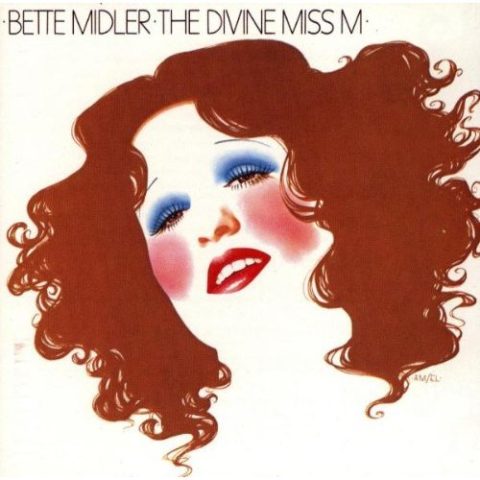
Nowhere is this more obvious than on Midler’s debut album, The Divine Miss M, released by Atlantic Records half a century ago, in November 1972. This was the year of Curtis Mayfield’s Super Fly and David Bowie’s Ziggy Stardust, of Stevie Wonder’s Talking Book and Neil Young’s Harvest. Roberta Flack, Don McLean and Harry Nilsson ruled the American charts. Listening to Eddie Kendricks and Iggy Pop, you could hear the early rumbles of disco and punk.
The Divine Miss M sounded nothing like any of that music. Midler was 26 and already looking back, covering the Andrews Sisters’ wartime hit “Boogie Woogie Bugle Boy,” the Shangri-Las’ “Leader of the Pack” and the Dixie Cups’ “Chapel of Love.” (Check the lyrical sentiment: “Goin’ to the chapel and we’re gonna get married/Gee, I really love you.”)
Then again, these songs were juxtaposed with an understated rendition of John Prine’s wrenchingly conversational “Hello in There,” and the funky, sexy “Daytime Hustler,” which had the kind of drum break hip-hop dreams are made of. Look closely at the credits and some names may stop you in your tracks: jazz bassist Ron Carter here; future architect of the Philadelphia Sound Thom Bell there. And then there was Midler’s music director and accompanist, Barry Manilow, who is now associated with a certain kind of sappy romance but was then proving his mettle as an inventive orchestrator and arranger.
The album was all over the map, a sui generis synthesis of styles and moods stretched between “normcore” aesthetics and cabaret showbiz, campy humor and heartfelt confession — sometimes all at once. And it worked: The Divine Miss M reached No. 9 on the Billboard albums chart and spawned three hits: “Do You Want to Dance?,” “Boogie Woogie Bugle Boy” and “Friends,” which Midler used to open and close her live sets.
Writing almost two decades after the release of The Divine Miss M, the critic Robert Christgau posited in the Village Voice that “this exercise of taste was prophetic and liberating. Ultimately, she was claiming the entirety of American popular music, which is why she also covered Glenn Miller, the Andrews Sisters, Bessie Smith.” For him, “Bette Midler was helping to rearticulate the rock canon.”
Midler’s uncanny grasp of the various forms of the American pop vernacular may have had something to do with a generous, open-minded artistic temperament. But it had also been refined by the demanding crowds at her regular live gigs, especially in New York — the city where she forged her reputation as a versatile interpreter (and a quick-witted stage animal) long before The Divine Miss M.
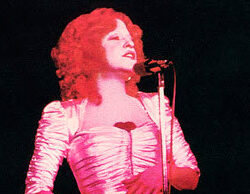
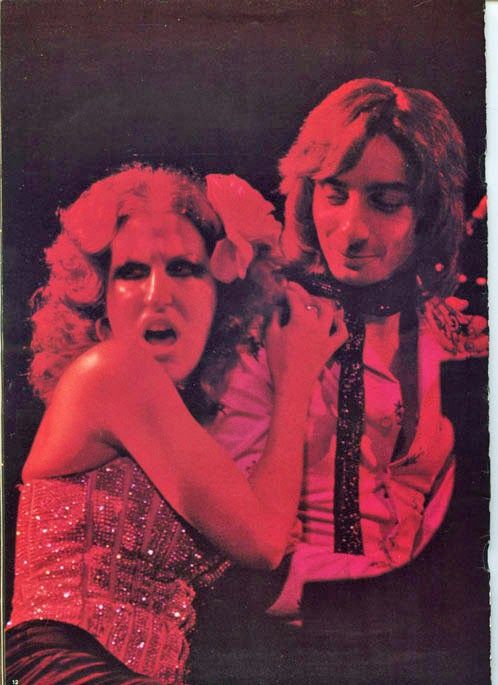
Most infamous were her regular gigs at the Continental Baths (nicknamed “the Tubs”), a gay bathhouse with a small performing area in the basement of the Ansonia Hotel on Manhattan’s Upper West Side. She began performing there in the very early 1970s, backed by Manilow on piano. “You never saw anything like it,” he told Vanity Fair in 2011. “It topped anything Lady Gaga is doing today. And she did it without any stage tricks or fancy effects. It was just Bette and me and a drummer.”
Propelled by live shows that were becoming the stuff of legend, Midler got herself on television, too. Thanks to social media, musicians today can achieve fame without a proper release. It was a very different situation 50 years ago, when you needed some vinyl to be played on the radio, at the very least. But her debut album was still over two years away when Midler made the first of her many appearances on the Tonight Show with Johnny Carson. Midler’s fan base grew so much that in June 1972 she rented Carnegie Hall, and filled it. Not too bad for someone who referred to her artistry as “trash with flash.”
Having built her reputation on stage and TV, Midler signed to Atlantic Records, a move representative of the label’s evolution from a soul and R&B powerhouse in the 1960s to one dominated by rock acts in the 1970s. Not, as should be clear by now, that Midler was your run-of-the-mill rock act. That cover of Bobby Freeman’s 1958 hit, “Do You Want to Dance?,” for example, was slowed to a sultry, breathy crawl, and featured horn and string arrangements by Bell, with Cissy Houston popping up among the background vocalists.
Manilow ended up sharing producing and arranging duties on The Divine Miss M with Ahmet Ertegun, Geoffrey Haslam and Joel Dorn, who regularly worked at Atlantic. Another of Dorn’s triumphs, Roberta Flack’s “Killing Me Softly With His Song,” beat Midler’s “Boogie Woogie Bugle Boy” for Best Pop Vocal Performance, Female, at the Grammys in 1974.
Midler did win Best New Artist that year, receiving the award from Karen and Richard Carpenter. Ironically, in 1971 Richard Carpenter had decided to cover the Delaney & Bonnie song “Superstar” after hearing Midler perform it on the Tonight Show, and the duo’s version was a hit. Picking up her trophy, a beaming Midler dryly said, “My dear, isn’t that a hoot? Me and Miss Karen! I’m surprised you didn’t hit me over the head with it.” (And yes, “Superstar” is included on The Divine Miss M.)
With all this in mind, it’s no wonder that The Divine Miss M was so varied. And it managed quite a few surprises. Midler’s brash, larger-than-life persona was well established, for example, but the album could often be startlingly emotional. She was also fairly straightforward and never mocked the material. Embracing the likes of “Do You Want to Dance?” (even reimagined) and “Chapel of Love” might have felt a little regressive shortly after the countercultural explosion of the late 1960s, but Midler sounded as if she was sincerely longing for true romance — and that felt almost radical. Not to mention that her open embrace of and by the gay community was the exact opposite of regressive, especially in the early 1970s. Her music and its context suggested that love and acceptance were something everybody should be allowed to find.
Those are values that don’t really grow old, and Midler has never stopped espousing them. No wonder that it’s “Friends,” rather than “Wind Beneath My Wings” or “From a Distance,” that will go down as her true signature song.