BETTE MIDLER
The acclaimed actress, comic, and singer, 80, on finding her way to stardom, the love of the gay community, and fighting Trump
Rolling Stone (USA)
Interview by CT JONES
2 Jun 2026
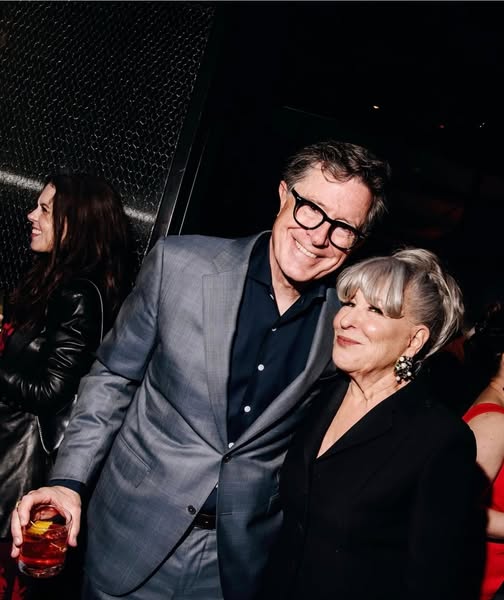
Photo by VNina: Stephen Colbert with Bette Midler at his wrap party, the final night
BETTE MIDLER
The acclaimed actress, comic, and singer, 80, on finding her way to stardom, the love of the gay community, and fighting Trump
Rolling Stone (USA)
Interview by CT JONES
2 Jun 2026
“I wanted to be up there in the light.”
What was the moment you thought acting might be for you?
The first time I ever saw a show, I was about 14 years old. I was helping the librarian of my school collate books. She didn’t pay us, but she gave us two tickets to see a show. It was [Rodgers and Hammerstein’s] Carousel. The curtain went up, and the lights went on, and I just couldn’t believe what I was seeing. I never forgot it. I wanted to be up there in the light.
When did you have an inkling you could make a living at it?
I went to college as a drama major, but only lasted about a year. I was cast in [the 1966 film] Hawaii, with Max von Sydow and Julie Andrews, and they brought me to L.A. along with a bunch of other locals. And I thought, “Oh, I can manage this.” I earned enough money on that movie to move to New York. I started going to auditions on Broadway, and I got into Fiddler on the Roof.
In the early Seventies, you started performing at the Continental Baths, a gay bathhouse in New York. How did that come about?
One day, I got a call from my old acting teacher. He asked me if I wanted to sing at the baths. And I said, “What’s the baths?” When I was in Fiddler, I was working for $200 a week and I had asked them for a
$25 raise, and they said, “Never.” He told me what [the baths] paid, and I dropped everything. I put the show on in the gay bathhouse. I would be my most outrageous self. When I went on the stage in front of all those gays, they threw their hands up and screamed. And it was great fun. We went from 30 people in the house to hundreds. Because it was such an odd venue, and transgressive in those days, we were a huge hit.
As a young woman in showbiz, how did you look out for yourself?
I got a very aggressive manager named Aaron Russo. He thought I was the greatest thing, and he just pushed, pushed, pushed on my behalf. I was so grateful. We were a team. I was really not a schmoozer, so he did all the socializing. That went very well until it didn’t go very well. Things between us got very feisty because he wanted 50 percent. I’m dumb, but I’m not that dumb. I know 50 percent means half, and I didn’t think that was fair. Sure, he was doing the schmoozing, but I was doing the sweating in high heels. So I said, “Absolutely not. You’re fired.”
Given how close you became with the gay community, how did it feel to witness the AIDS epidemic?
That was one of the worst things that ever happened to me. I must have lost 200 people that I knew, many close friends. It’s funny, the older I am, the angrier I get — the cruelty of it, that the government didn’t do anything. Five hundred thousand people were dead before they did anything. It’s unconscionable.
Do you think that experience is why you’re so direct about calling out the government now — including President Trump?
I lived in New York during Donald Trump’s [rise], and everyone in the city felt the same way about him. Everybody knew his game, and everybody thought he was hilariously dubious. Everybody just thought he was a joke. So why do I feel like it’s my duty? Because I know what the truth is. When I see someone who’s not just undeserving, but incompetent, it infuriates me.
What are some roles that you wish you hadn’t turned down?
I turned down Misery. I [didn’t] think I wanted to have it on film that I cut off someone’s foot, because audiences identify the actor with the event. My husband still says I’m a damn fool. And I turned down Sister Act because I said, “My fans don’t want to see me in a wimple.” And Whoopi [Goldberg] said, “Bring on the goddamn wimple.”
What’s the first lavish purchase you made with showbiz money?
It must have been shoes. When I was a kid, I had one pair of saddle shoes I wore year after year after year until my feet got too big for them, and then I got another pair. So, I coveted high heels. I started collecting heels and vintage clothes. As far as a huge purchase, I think it was my house. I bought it in 1980, and I’m still there.
Who’s inspired you?
Female comics! Phyllis Diller and Joan Rivers, who are not just inspirations, but who lifted me when I was in the doldrums. I can’t wait to join them in that big comedy club in the sky.
What are some rules you live by?
Fairness. Be fair. Not just a day’s work for a day’s pay, but also don’t put yourself above anybody. And after that, kindness. My dad was a fucking house painter. My mom stayed in the house. I wore homemade clothes until she discovered the Salvation Army. That stuff imprints itself on you. I identify with the working class, and I don’t intend to budge. I want there to be a middle class. I want people to thrive. I want people to be treated fairly. These assholes treat themselves really well, but treat everybody else like shit. What kind of a world is that?