Syracuse Herald American
“I Can’t Play The Victim”
B Y T O M S E L I G S O N
Sunday, February 5, 1989
I ALWAYS BELIEVED THAT I was as good as the next person,” said Bette Midler. “Although I’m also quite vulnerable, and there are times when I’ve lost faith in myself and have pretended things were okay when they weren’t. I didn’t want people to know that there was a hapless person in here.”
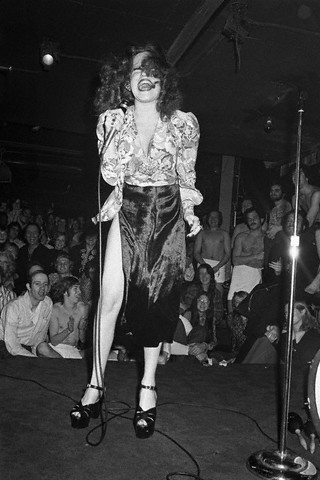
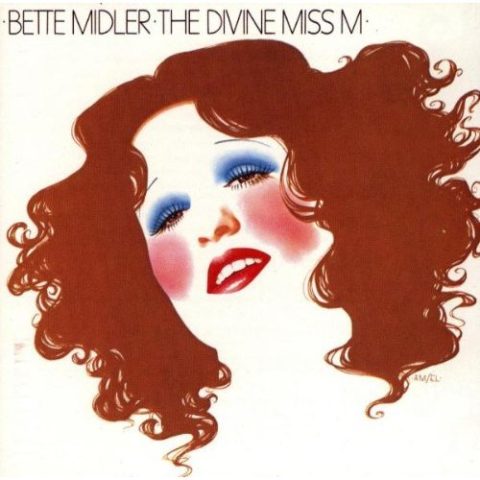
Bette Midler has always projected an image of cocky self-assurance–whether as the larger-than-life “Divine Miss M”
she created for her early concert tours or as the brash, wisecracking heroines of her recent movies. Yet, personally,
she has had good reasons to feel vulnerable. She has gone years when no one would hire her as an actress. And she has suffered a number of failed relationships and family tragedies that have tested her. What sustained her during those
periods? And how has she changed, if at all, now that her career is flourishing again and she has a family of her own?
To learn more about the private Bette Midler, I visited her in her Mediterranean house high above Beverly Hills. While most of Bette’s film characters live in gaudy and pretentious homes, hers is simple, though elegantly decorated. The wood-beamed living room where we sat is tastefully furnished with a baby grand piano, a colorful couch and chairs, a mosaic-tiled fireplace and her collection of artwork and antiques, including baby shoes and a portrait of the silent
movie star Mary Pickford.
Bette seemed much smaller in person than she appears on the screen, standing barely 5 feet 1. She wore no makeup and was casually dressed in a black sweatshirt, black tights and no shoes. Her hair, which she confided is naturally brown, was bright red. “This is my favorite,” she said, laughing.
Curling up on the couch, Bette explained that if she seemed a bit tired it was because she had been working so hard putting the final touches on her new movie, Beaches. Unlike her recent comedies, it’s a drama, following the friendship of two women (Barbara Hershey co-stars) over 30 yews. One of the women is a performer, and in many respects the film is about Midler’s own life.
“I never had a friendship that lasted that long,” she said. “But I had a very dear friend when I was young. 1 was in
the 10th grade when we met, and she’s the one who brought out whatever sense of humor I have. She was only 19 when she died. Since then I’ve had a good friend here and there, but nothing like that. You know, there’s a kind of emotional exploration you plumb with a friend that you don’t really do with your family. You don’t spill your guts, because you don’t want to worry them. Of course, in crisis times, nothing beats your family.”
Midler’s parents originally came from New Jersey. Her father, a civilian house painter for the Navy, moved the family to Hawaii, which is where Bette was born, the third of four children. Her mother, who liked show business, named her after Bette Davis. One of her older sisters is a health-care executive in New York who until recently cared for her younger, retarded brother. The family was extremely poor and lived in military barracks in the middle of the cane fields before moving to a simple apartment.
To this day, I don’t know how my mother was able to raise us,” Bette said softly. “She found her circumstances
humiliating and didn’t want anyone to see her living like that. But at the same tine, she tried desperately to get out.
She wanted us to have a home and when my father brought home his paycheck, she immediately put it in the bank. Eventually, they got enough money to put a down-payment on a group of homes and became landlords. But they never moved
out of that apartment. My parents were two of the most conservative people you’ve ever seen in your life. They never went to a movie. And we didn’t get a TV set until 1957 or a phone until 1962.”
Bette recalled a lot of tension and fighting in the family and described her father as a dominating man who always put
her down: “He was one of those poohpooher’s–’You’ll never amount to a hill of beans.’ Maybe it was reverse psychology, hoping against hope that I would amount to something, but it was pretty painful for a long time. However, I used to fight back a lot. He couldn’t keep me down. I had too much inner belief. That cane from my mother, who always said,
“Kid. you’re going to be fine.”
That emerging self-confidence came in handy at school in Hawaii where, being one of the few white children and the only Jew, she was totally isolated. “I was resented and teased by the other kids,” she said. “It was bad being treated like
that. But you toughen up fast. I guess that’s where 1 got my ‘showoffedness,’ because I had to entertain. I would sing
and dance and tell jokes.”
In the first grade, she won an award for singing “Silent Night.” “I got big applause, and a lightbulb went ofT in my
head, Bette recalled. “Then I won a prize in the sixth grade and that was a big thing, too, I said, ‘Maybe I have something here.'”
The theater quickly became her love, and she acted in all the high school plays, always as the star. “My mother really
ate it up,” she said, smiling at the memory. “I remember her coming to the senior-class play and handing me roses over the footlights, her face just shining. She just thought this was great.”
Buoyed by her mother’s encouragement, Bette spent a year studying theater at the University of Hawaii before heading for New York. “I wanted to get on with it,” she explained. “1 wanted to go to New York and make my mark.”
Bette Midler didn’t exactly take New York by storm. She acted in children’s theater and some minor revues, while
supporting herself as a hatcheck girl, a salesgirl at the glove counter in Stern’s department store and as a go-go dancer. This was before topless.” she said, grinning. “I was all covered up and wore those little white boots. I actually enjoyed it, because I like to dance.”
Bette eventually won a part in the chorus of Fiddler On The Roof, and while a casting agent tried to discourage her from auditioning, she later won the role of the eldest daughter, which she played for three years. Her professional life was beginning to take off–however, her personal life was still exceptionally painful. Her oldest sister–who had never really survived their early circumstances, becoming anorexic in high school–was killed by a car in the theater district while on her way to see Bette’s show. Bette had to go to the morgue to identify the body. Twenty years later, the loss is still difficult to talk about.
What she is candid about is the singlemindedness that marked those days. “At that point, I decided 1 would never get
married,” she said. “I put that completely out of my mind. All I was interested in was my career to make my name and
fortune and to become a star”
She shook her head. “You know, it’s not until you get older that you realize how incredibly juvenile that quest for
fame is. You say to yourself,’ What was I thinking about?” Fame is not what’s important. What’s important about work
is skill and experience, the ability to create and make something beautiful.”
Bette’s initial creation was her nightclub act. She’d been singing in clubs around New York, perfecting a heart felt torch style similar to Ruth Etting, Libby Holman and Aretha Franklin, who were her models. One night, while performing at the Continental Baths, a gay men’s club, she added her unique brand of sassy humor.
Barry Manilow, who was Bette’s pianist and arranger at the time, remembers that night vividly. “We had been rehearsing together all week,” he recalls, “and when she walked out there looking like Carmen Miranda with apples on her head,
this was not the Bette I knew. She’d become the Divine Miss M. I had never felt such electricity. I found myself
laughing hysterically at her jokes, weeping during her ballads, and at the end I was on my feet with everybody else,
cheering for her. I had never seen anything like it. Nobody has to this day.”
Manilow worked with Midler for three years and is still friendly with her. “Even then, the private Bette was very different than she was onstage,” he says. “She’s amusing, but she’s actually very serious and bright–and quiet. I always say she has the soul of a librarian. I learned a lot from Bette. She was one of the most insecure people I’d ever met, but at the time she took the most risks.”
If Bette had doubts about herself, others did not. Aaron Russo, a dynamic man who became her manager–and for a while was her lover-–began booting her into theaters. With the help of appearances on The Tonight Show and her soldout performances across the country, Bette Midler soon became a bona fide star. She won a Grammy Award as Best New Artist of 1973, wrote a best-seller, The Saga of Baby Divine, and won an Oscar nomination for her performance
in The Rose, her first major film role.
I asked her about the impact of this success.
“I didn’t die from it, I’m proud to say,” she replied evenly. “I did survive it. And I survived it by being basically kind of cynical. I never let it go to my head. I always thought it was ephemeral, that it would disappear and didn’t reaily mean that much anyway.”
What did mean a lot to her was something she never received. “My father never went to see my performances,” she
confided quietly. “I think he saw The Rose on television, and he saw me on the Johnny Carson Show., but he just
wasn’t interested. He didn’t like popular culture. He thought it was garbage. If I had been an opera singer–that he
would have understood, or a professional person… Her voice trailed off.
“What about your mother?” I asked. “Did she enjoy your success?”
“Yes, and I’m really happy about that,” she said, standing and walking across the room. She took a box of tissues from
the table and carried them back to the couch. “If she had passed away…and I wouldn’t have brought her anything… I
would have been devastated. She made huge sacrifices’ huge, huge.”
Bette took a tissue and dabbed at her eyes. “I t h i nk I made her happy,” she said, her voice barely audible. “I
think we all did…I’m sorry. I get very emotional about these family issues… I don’t know why.” She blew her nose. “I think it’s very primal–how they treat you. Some people go to therapy and work it out, but I never got around to it . . . At the end. .. when my mother died . .. it was very bad.”
Bette began to cry quietly. Neither of us spoke, while she breathed deeply, trying to control herself. She looked small
and very vulnerable, her feet folded beneath her shirt.
“Do you want that picture of Mary Pickford?” she said at last, to change the subject. “I’m really tired of it.” I shook my head and said, “Why don’t you put up a picture of you?”
“Get real” she replied, suddenly the outspoken Bette Midler from her movies. “That’s hardly my taste. I try not to be pompous. That’s something my dad did give me. He had no patience for that.”
Having regained her composure, Bette recalled how her early success was not to last. “After The Rose [in 1979], no one offered me any work, which came as a big surprise and disappointment for me,” she said. “And then I left Aaron. So suddenly I was on my own. It’s pretty hard to be on your own for the first time. I had counted on him for a lot. And when he wasn’t there, I made a couple of bad mistakes.”
Her biggest was choosing to make a movie called Jinxed, “I did it because my agent told me that I would never work
again if I didn’t,” she explained. “My whole life I had never believed anybody who said something like that. But at that point I didn’t trust myself.”
When the film lived up to its title, bombing critically and at the box office, Midler was blamed by both her co-star
and director, who attacked her viciously in the press. Bette’s mother died about the same time, and it all became too much to bear. She suffered a nervous breakdown, staying in her house and crying. The depression lasted for months.
“The experience with Jinxed really shook her up,” recalls Barry Manilow. “She was put through the ringer, and when
I saw her after that, she seemed like she was in shell shock. She certainly wasn’t as energetic and rebellious as I remembered her. She was a beaten-up girl.”
I asked Bette how she eventually pulled herself together.
“You get bored being in that state,” she said calmly. “You say to yourself, ‘I’ve done this now for three months. I’ve cried this many tears. I guess that’s enough.’ It’s like a purification. I cleaned out my closets, cleaned out my life, until I finally felt strong enough to return.”
Helping Bette regain her strength was a new man in her life: Martin von Haselberg, a former commodities trader who,
under the name of Harry Kipper, is now a producer/performance artist. They had met briefly in 1982. When they got together again in 1984, it was love at second sight. Two months later, they were wed.
“He was exactly what I was looking for,” said Bette. “I had nobody to tell my troubles to. And I wanted to settle
down. I wanted to have a family. I was really ready for t h a t. Not that I h a v e n ‘t had to work at it,” she explained, s i t t ing up straight. “Marriage involves big compromises all the time. International-level compromises.
You’re the U.S.A., he’s the USSR, and you’re t a l k i ng nuclear warheads.” She laughed. “To me, it’s really like that. When you’re used to being on your own, being single-minded and self-absorbed, it’s a big thing to listen and pay attention to someone else.”
Bette flashed a familiar grin, looking both cocky and tentative at the same time.
“But I’m learning.” Her husband also helped Bette revive her career. “Harry’s the one who pointed her back toward comedy,” says Bonnie Bruckheimer-Martell, a partner in Bette’s production company. “He said, ‘You’re so funny. Why don’t you go be f u n ny in the movies?'”
Which is exactly what she has done–in Down and Out in Beverly Hills, Ruthless People, Outrageous Fortune and Big
Business–so successfully that Disney studios has Bette under contract. They are now bankrolling her movies, such as Beaches, which displays the full range of her talents.
Ironically, this newfound success comes at a time when Midler needs it least. “She realizes that having work is
wonderful, and she’s thrilled that she’s doing so well ,” says B o n n ie B r u c kheimer-Martell. “But she now realizes that it’s not the most important thing in the world. Her priorities have changed.”
The main reason is that she has become a mother. Her daughter, Sophie, is now 2 years old. “The baby has changed my
life in a really wonderful way,” Bette said. “I never thought I would meet anyone I was so fascinated with. This joy
that radiates from her–this innocence and sweetness. She’s like a walking entertainment center. I can’t look at her, touch her or be near her enough. I count myself so lucky to have her.”
Bette and her husband are eager to have another child. Though she suffered a miscarriage last April, she is not about
to let this or any other misfortune keep her down. Bette finally even came to terms with her father, nursing him before
he died in 1986. “I got very close to him,” she said. “I just can’t play the v i c t im.
You know, a lot of people tell me I was their role model when they were in college, and that makes me feel fabulous.
Maybe it’s because of my straight talk and that, despite what has happened, I lived through it. Sure, things have been
rough, and I wouldn’t want to live through them again. Al t h o u g h, I ‘ ll tell you–you’re up, you’re down, you’re up, you’re down, and then it’s over with. Ultimately, I have no regrets, because it has all turned out for the best. I like exactly where I am.









Cool, glad i found it! Just for you….